


Nice Corp., a distributor of housing and construction materials based in Kanagawa Prefecture, has been developing timber products that leverage Japan’s abundant forest resources.
Central to this effort are ObiRed, which maximizes the characteristics of sugi (Japanese cedar) grown in the Obi district of Miyazaki Prefecture, and Gywood, a cedar product that has undergone surface compression to improve its strength.
In a recent online interview with The Japan Times, Manager Yoshinori Aoki of Nice discussed these products, the techniques used to make them and their potential for global expansion.
The ObiRed timber brand uses the heartwood of Obi cedar, a variety that has been cultivated in planted forests for over 400 years. Miyazaki has been Japan’s top producer of cedar logs for 34 consecutive years. Among these cedars, Obi cedar is known for its fast growth, which contributes to the development of a large heartwood section.
Aoki explained that the heartwood is naturally rich in oils that enhance its durability and resistance to decay.
“We focused on these superior qualities of the large heartwood section, obtainable only from large-diameter logs,” he said.
Historically, this wood was used for shipbuilding, which requires high resistance to water and decay.
A critical step in manufacturing ObiRed is the drying process, which is designed to reduce the wood’s moisture but preserve its oils. Conventional industrial drying methods, which often employ high temperatures for efficiency, risk causing these natural oils to leak.
To prevent this, freshly sawn heartwood is first sun-dried naturally for an average of six months. After drawing out a significant amount of moisture during this process, the wood is inserted into a mechanical dryer, where the temperature is carefully maintained at relatively low levels to prevent degradation of the oils. This process typically takes one to two weeks.
Thanks to this time-consuming and labor-intensive drying process, ObiRed maintains both the high durability of Obi cedar and the textural quality granted by its oils. This lumber is marketed primarily as material for decks and fences.
ObiRed also offers a solution to the surplus of large-diameter timber in Japan’s forestry industry. Among planted forests, which account for about 40% of Japan’s forested area, cedar is the most widely planted tree. In fact, roughly 44% of the planted forests consist of cedar plantations, according to Forestry Agency data for 2022.
In the past, most of the wood was primarily used to make posts for traditional Japanese houses. Since thinner logs were preferred for this purpose, demand for logs over 30 cm in diameter was limited. To make matters worse, demand for solid wood gradually declined as cheaper laminated timber and imports gained traction, leaving these mature uncut trees to grow even larger.
But ObiRed has effectively transformed this surplus resource into a high-value product.
ObiRed’s value and potential have been further amplified by Nice’s newer cedar product, Gywood, a type of lumber made by applying pressure to the wood’s surface to increase its density for improved durability and resistance to wear and tear.
Before other advanced, chemical-free techniques are applied, the process of manufacturing Gywood begins in the forests.
“Proper pruning and thinning are necessary to cultivate straight, high-quality trees,” Aoki said. Once the trees reach the proper size, skillful harvesting is required to preserve each log’s unique characteristics, such as knots and slight bends. Advanced sawing techniques are also employed to maximize yield and quality.
After the sawing comes the drying process.
“Timber for Gywood is dried to achieve a moisture content of around 10%, which is slightly lower than the standard for drying conventional structural lumber and interior materials. It is through this relay of Japanese wood-processing techniques that Gywood achieves its high strength and dimensional stability,” Aoki said.
According to the Mokuzai Kougyou Handobukku (Lumber Industry Handbook) from Maruzen Publishing, the average density of Gywood decking material — including both surface and core layers — is lower than Mizunara oak (Quercus mongolica var. crispula), but its surface strength remains comparable.
Applying the Gywood hardening process to the already durable ObiRed, however, results in a product with enhanced strength and dimensional stability.
By carefully observing product characteristics and fine-tuning the related processes and machinery, other types of wood can receive the Gywood treatment as well.
Nice plans to utilize Gywood technology to develop products from all 47 prefectures in a bid to rebuild and revive Japan’s “wood culture.”
Gywood is being used for a range of applications in Japan from flooring and exterior walls to furniture. Its enhanced water resistance and durability also make it suitable for kitchen countertops when properly coated.
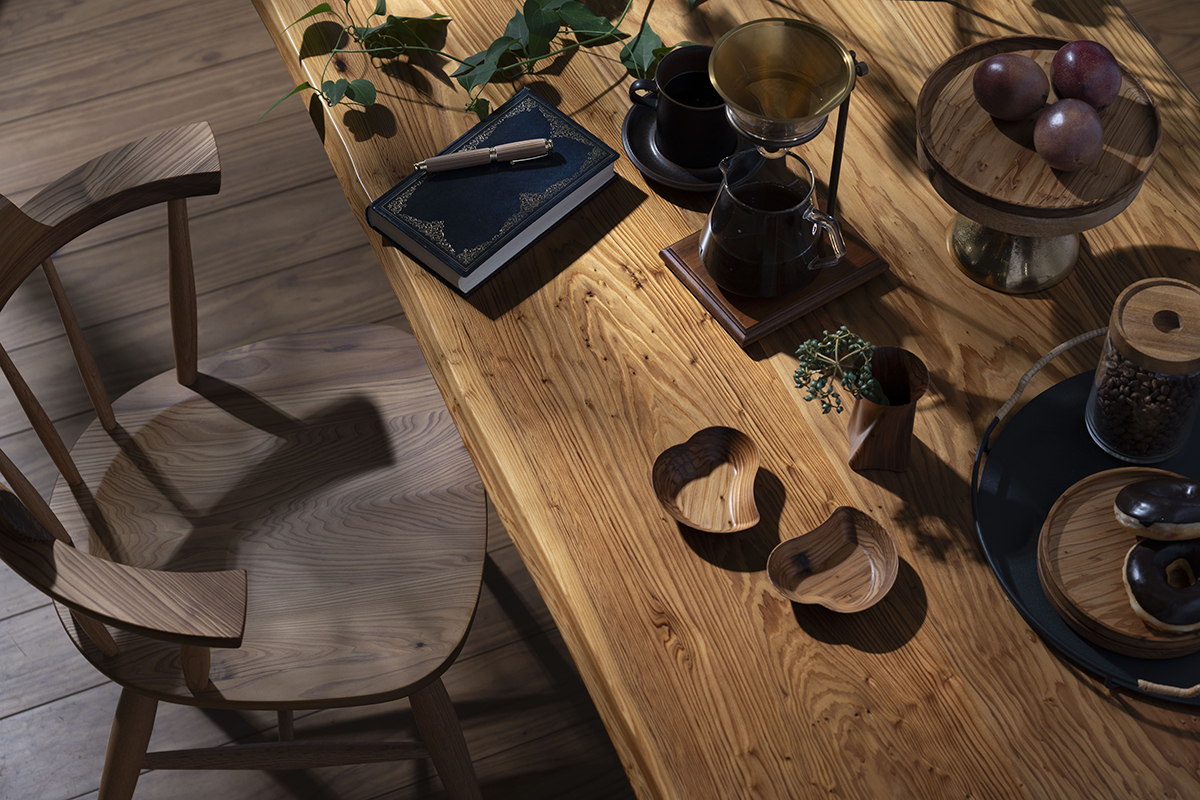
Beyond construction, Nice is actively collaborating with manufacturers to bring Gywood to other consumer products.
“We are engaging in joint product development with various companies, such as a stationery manufacturer, so the material can be used to create a wide range of items that people use every day,” Aoki said.
Aoki hopes Gywood will contribute to sustainability by replacing plastic components in various products.
“For items touched by human hands or feet, using materials that offer warmth and a natural scent is better from the perspective of human well-being,” he said.
Furthermore, while hardwood timber is generally dense and heavy, Gywood timber can be strong and light at the same time, because only its surface undergoes the high-density treatment process. This makes it suitable for furniture that is moved frequently and for truck bed flooring.
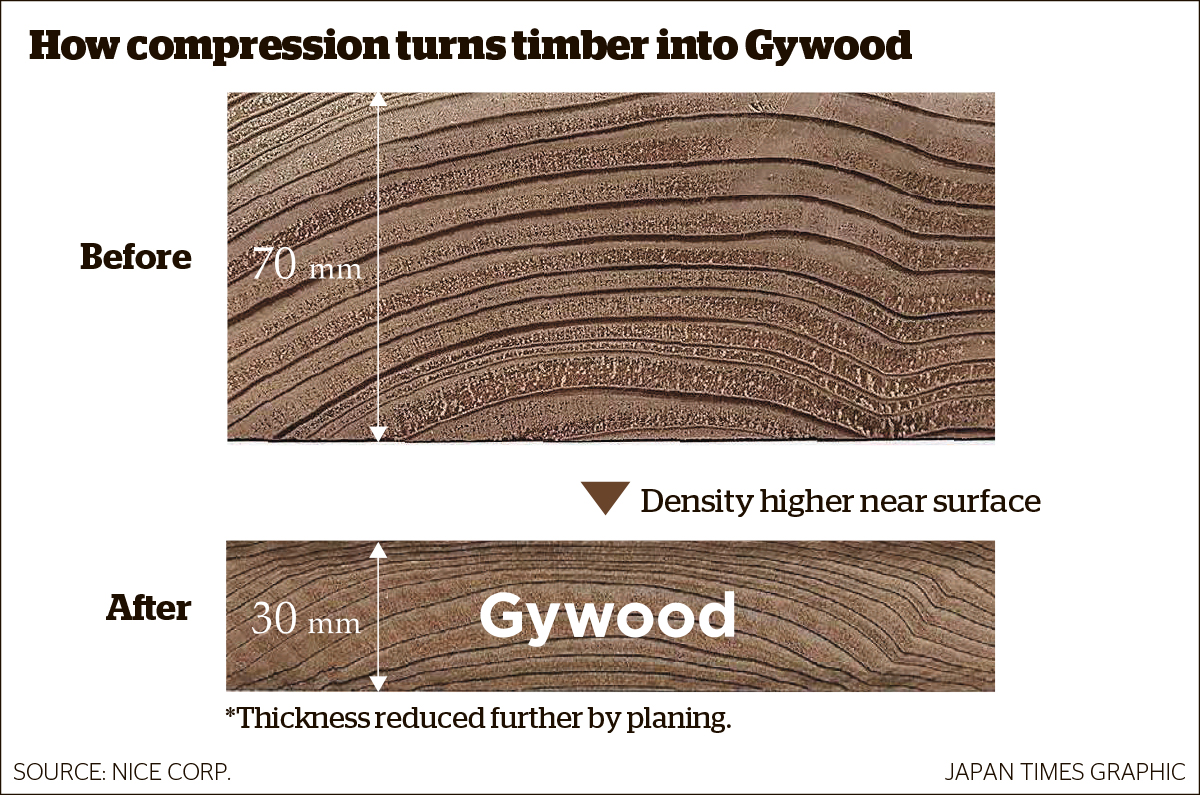
Aoki described the Gywood process as “technology that transforms softwood into hardwood,” suggesting its substantial potential to meet global demand for strong, durable timber.
“Globally, large-diameter hardwood logs are becoming scarce. Prices for some species are soaring,” he said. He also pointed out that there are concerns over environmental degradation due to excessive logging of natural forests in some parts of the world. Aoki believes that Gywood — made from Japan’s abundant planted forests and engineered to match hardwood strength — has the potential to meet global demand for a sustainable alternative to natural timber.
Both ObiRed and Gywood are rooted in the principle of sustainable forestry. Aoki described Japan’s planted forests as yama no hatake (mountain farms) that have been managed for hundreds of years in many regions. Its forestry techniques have developed over centuries to suit the climate, topography, soil and timber practices in each region.
Even if domestic demand continues to decline with Japan’s shrinking population, an increase in overseas demand could sustain its forestry industry and save forests from neglect. It could also help prevent Japan’s sophisticated silviculture and wood processing techniques from vanishing.
At the International Builders Show held in Las Vegas in February, Nice showcased Gywood and other products at a joint exhibition organized by the Japan Wood Products Export Association.
Aoki said the reception was so positive that he renewed his determination to venture into the global market, leverage Japan’s forestry techniques and promote sustainable resource development.


