


Toshu Fukami, who also goes by the name Haruhisa Handa, held a concert at Tokyo’s Nippon Budokan, one of Japan’s most prestigious concert venues, on May 21. The 75-year-old baritone performed for three hours, entertaining an audience of around 8,590 people.
The setlist featured 22 songs spanning a variety of genres, including rock, pop and Latin, as well as a lyrical piano solo piece, all of which were composed by Fukami. Three of the songs he sang in the first half of the event were love songs he had written around 10 years ago. However, the titles and lyrics of most of the other songs were more eccentric, with songs about food, such as grilled sweet potato, tempura and yakitori; songs about the dragon god; and a song about sparrows with metabolic syndrome.
There were also songs highlighting the characteristics of the prefectures around Tokyo, such as Chiba, Saitama, Gunma, Tochigi and Ibaraki, using humorous expressions. These prefectures are often teased for being somewhat unrefined compared to Tokyo. “In these songs, I’m praising and making fun of the uniqueness of those prefectures at the same time. It’s my way of expressing my love for them,” he said, prompting laughter and cheers from the audience.
Fukami touched on the recent trend of people using artificial intelligence in just about everything, as well as AI’s potential in creative activities. He said: “But these songs are beyond AI. I wanted to create the kinds of songs that AI wouldn’t be able to produce; then my songs got weirder.” The audience laughed and applauded.
The line-up of a dozen backing musicians featured top players from a variety of genres. They included Ayumu Koshikawa, a violinist who has played with renowned artists such as Ryuichi Sakamoto and Bjork; Yuhei Kimura, a pianist who also made his debut as an opera conductor last year; and Daisei Mitsui, a violinist who has performed in concerts and recordings with well-known Japanese artists.
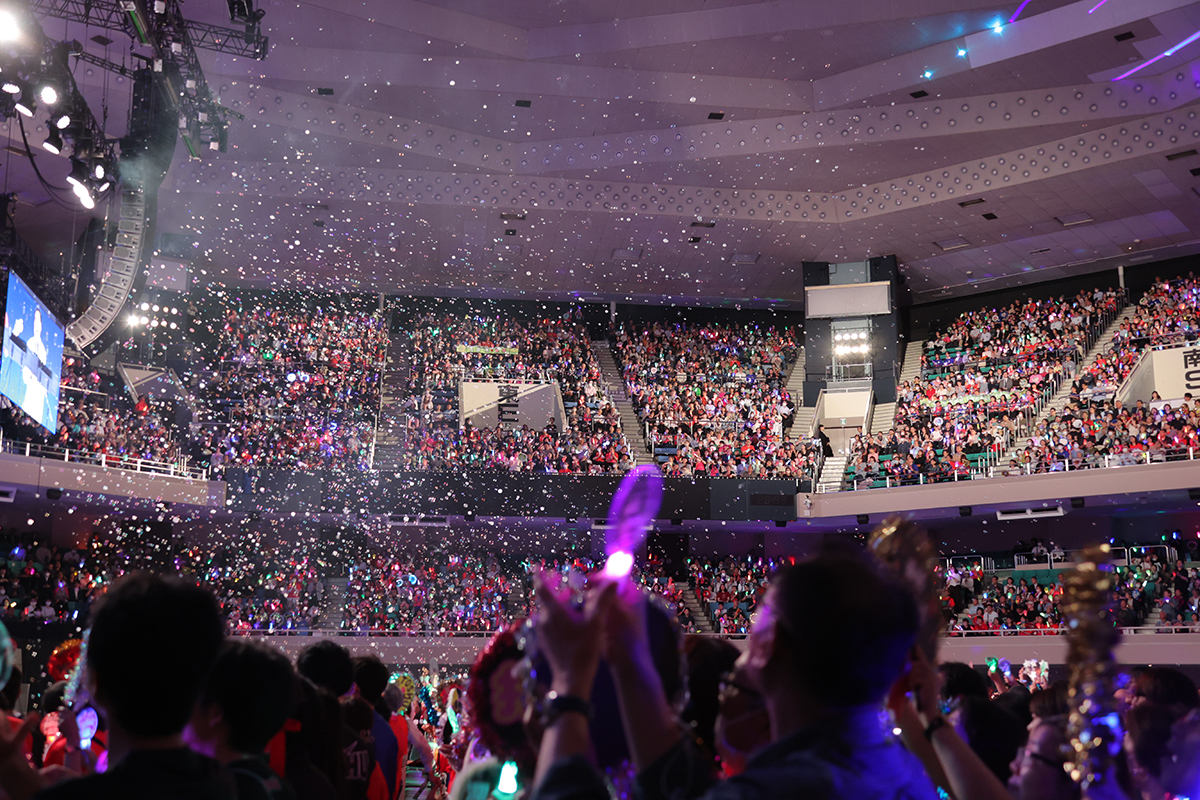
In addition to the rich sound produced by the backing band, the audience was thrilled by the dramatic stage effects, which included pyrotechnics, flying streamers and confetti, as well as a dragon dance. This was Fukami’s sixth concert at Nippon Budokan, which he said is one of his favorite venues because “the stage is very close to the audience,” enabling him to feel the audience’s response and passion more directly than in other halls.
As the final song ended, the applause did not stop, and the audience began to call for an encore. Fukami responded to the audience’s enthusiasm by performing four more songs. During the fourth song, he and the band wove in famous phrases from various operas, filling every corner of the octagonal hall with his baritone voice.
In addition to releasing 112 CDs and 49 DVDs as a singer-songwriter, Fukami has enjoyed a notable career as an opera singer. He has performed the title roles in Verdi’s “Rigoletto,” “Falstaff” and “Nabucco,” Mozart’s “The Marriage of Figaro” and “Don Giovanni” and Gaetano Donizetti’s “Don Pasquale.” He has also performed with various world-renowned opera stars, including Jose Carreras, Renee Fleming, Angela Gheorghiu and Placido Domingo.
Fukami began his musical training at 40, receiving a master’s degree from the Western Australian Academy of Performing Arts, as well as degrees in arts and music from other universities in Japan and abroad. He is a regular member of the China National Opera and Dance Drama Theater. He is also a conductor, ballet dancer, noh performer and comedian.
Music and theater are not the only art forms in which Fukami displays his exceptional talent. He is also a calligrapher, painter and writer, who has never stopped sharing his work with the world. Believing in the power of art, he supports various art forms, including music, theater, visual arts and art education, through his work as chairman and advisor to several art-related organizations, while running multiple businesses.
One of the organizations that Fukami chairs is the International Foundation for Arts and Culture, a nonprofit organization that supports the arts. Established in Tokyo in 1996, it now has branches in Australia, the United States and the United Kingdom. Another organization spearheaded by Fukami is the Tokyo Art Foundation, which was founded in 2011 to promote various forms of music and entertainment across Japan.
Fukami’s philanthropic activities extend beyond the arts. He is the chairman of Worldwide Support for Development, a nonprofit organization dedicated to providing social welfare and support to disadvantaged people and communities worldwide.
He is also the honorary president of the International Blind Golf Association, which supports blind golfers and their competitions worldwide. Fukami also chairs the International Sports Promotion Society, which provides extensive support for various sports organizations and events in Japan and abroad, including professional golf tournaments.

