


Koido Seizai Co. has been engaged in the lumber business in Gunma Prefecture since 1954 and has been shipping sugi (Japanese cedar) lumber to the United States since 2018. Yoshiharu Koido, the president, described the characteristics of sugi grown in Gunma in a recent interview with The Japan Times.
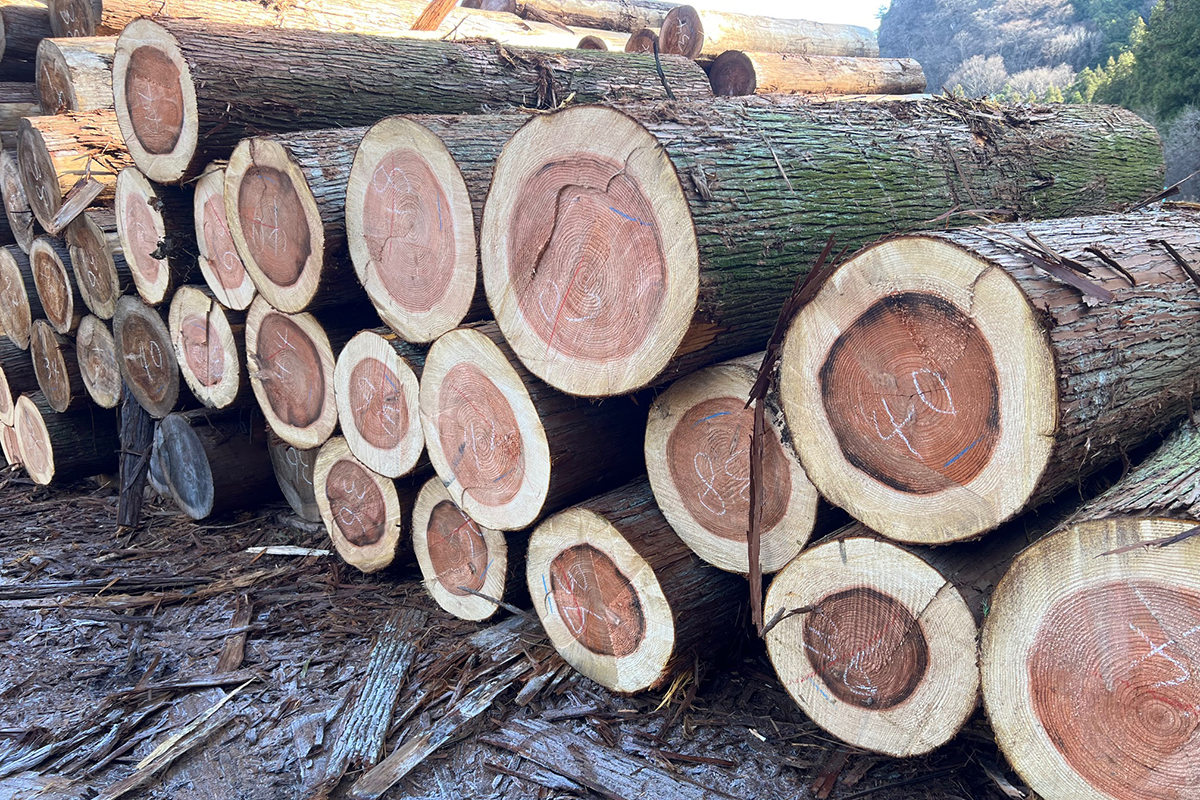
“The distinguishing feature of Gunma’s planted sugi forests is that many trees have been left uncut for 70 to 80 years, whereas sugi trees typically grow mature enough for logging in about 50 to 60 years. So many of the trees have grown thicker than the average size of harvested sugi trees,” he said.
Koido explained that one of the advantages of this thicker timber is its higher proportion of heartwood. Sugi generally has whitish sapwood around a reddish core. The heartwood contains more oils and is more durable, making it suitable for outdoor use.
Changes in architectural styles in Japan have contributed to the large number of trees growing past their normal felling age. The decline in traditional Japanese wooden architecture led to a decrease in demand for sugi, which had been traditionally used as a building material in Japan along with hinoki (Japanese cypress).
Gunma is particularly blessed with forest resources. Forests cover two-thirds of its land, making Gunma the prefecture with the largest forested area in the Kanto region. About half of these forests are planted, with Japanese cedar being the most common species, accounting for 27% of the total area of privately owned forests in the prefecture.
Among Gunma’s privately owned planted forests, those consisting of trees that are 41 years or older, ready for harvesting, account for 80% of the total. Sugi constitutes roughly 70% of the total timber in these privately owned areas.
Another advantage of Gunma is that it is located only about 100 kilometers from the Tokyo metropolitan area. “This means we are close to a major consumption area in Japan,” Koido said.
In 2017, Koido received an inquiry from a trading company, “Would you sell us lumber milled as fence material for export to the United States?” Gunma is a landlocked prefecture, but Koido said that this was not an obstacle to exporting timber, thanks to Gunma’s access to ports in the Tokyo metropolitan area.
However, this was not an easy request to fulfill. The standard lengths for general timber used in Japan are 3 meters or 4 meters. These lengths are generally for pillars, while 4-m timbers are also used for building foundations in Japanese-style construction.
But the size requested for export was 8 feet, which is about 2.44 m. To mill this efficiently with minimal waste, trees need to be cut to a different length when they are felled than those for the Japanese market are.
“Because of that, we were initially not very enthusiastic,” Koido said. However, about a week after the trading company contacted Koido, he learned that one of Koido’s long-standing partner sawmills was facing a crisis. The company had been a subcontractor for a major company, supplying large quantities of timber. However, that business relationship ended, leaving the sawmill without work.
Koido decided to accept the request from the trading company, and the production of 8-foot two-by-four lumber began. Since the partner sawmill did not have a dryer, the lumber cut by the partner was dried in Koido’s drying kiln. Eventually, the export volume increased and two other sawmills joined the collaboration.
Koido said that, given Japan’s declining population and the continued stagnation of the housing construction market, the stable demand for timber exports is greatly appreciated.
A stable supply of lumber is, of course, also crucial for importers. According to Koido, the biggest concern for retailers and companies that use timber is running out of stock. To win the trust of customers, it is vital that products are constantly available, and Japan has the necessary sugi lumber capacity to ensure this.
The lumber currently exported from Koido and its partners to the U.S. is known as kiln-dried rough lumber. They are currently exporting 10 different cuts of lumber, mainly in the 8-foot length. The products for the U.S. are loaded into containers that take about a month to ship by sea.
Koido uses drying kilns made in Japan that allow for subtle adjustments. These kilns dry the timber to an appropriate moisture content, thereby preventing mold growth during transport without overdrying it, so the lumber won’t crack.
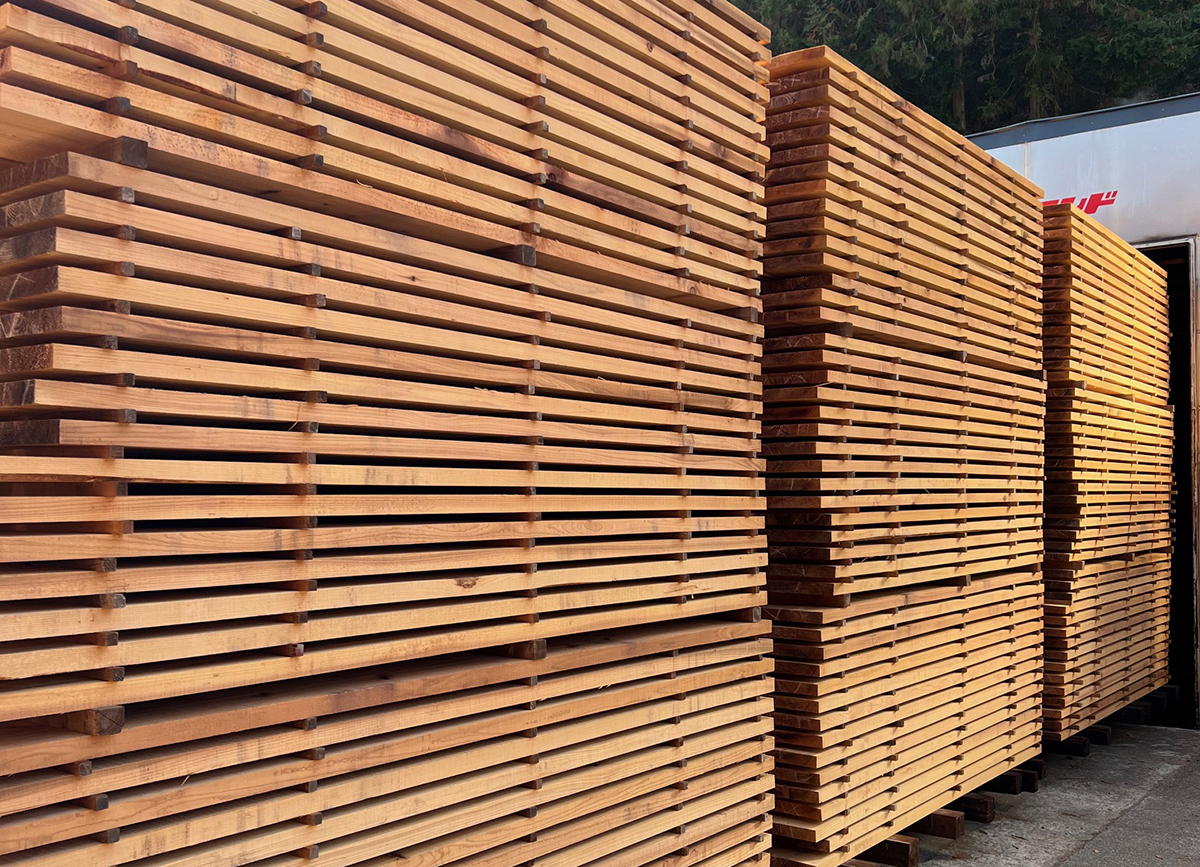
“In Japan, lumber with a smooth, planed surface is generally preferred, whereas the lumber we produce for export to the United States is deliberately left unplaned, with a rough surface,” he said. This is preferred in the U.S. market.
Koido believes this is because the lumber is used as fence material. “Paint spreads well on the smooth, finished surface. Conversely, a rough surface absorbs paint immediately, requiring multiple coats. This results in longer-lasting paint finishes and a reinforced surface. There is also an aesthetic reason, I think, where a slightly worn, rough look is considered cooler than a brand-new, cleanly finished appearance,” Koido said.
Koido noted that this is helpful for Japanese sawmills. “Many small-scale sawmill companies can cut the wood but lack the capacity for planing or other processing, and don’t have the resources for investing in new equipment. So, if rough cut lumber is what the U.S. market needs, that means these small companies can take part in the business, too.”
Koido intends to continue exporting sugi fencing materials to America while seeking out new opportunities from the diverse inquiries and requests they receive. Since Japanese cedar is often used as a substitute for western red cedar from North America, there is potential for Japanese cedar to be used in applications beyond fencing, Koido pointed out. There have been requests for processed Japanese cedar that is suitable for decking. Koido said they are considering this, taking into account the required strength and the fact that people may walk on the wood barefoot.
In April, the American Lumber Standard Committee’s Board of Review approved the design values of Japanese cedar two-by-four lumber, which is expected to increase recognition and exports of Japanese timber.
Promoting the use of sugi timber contributes to sustainable forest management. Sugi trees used to produce lumber come from planted forests. To keep these healthy, it is necessary to maintain the cycle of logging mature trees and planting new seedlings. Trees in their growth phase also absorb more carbon dioxide, while releasing oxygen.
Furthermore, unmanaged forests become dense thickets. Koido touched on the recent issue of the increased frequency of bears causing crop damage and threatening people, and pointed out that forests frequently entered by people for maintenance offer good visibility, while neglected forests provide hiding places for bears and other wildlife. This results in bears venturing closer to towns.
Managing these planted forests, which function as a buffer between deep mountains and populated areas, is crucial for maintaining the separation between people and wildlife.
Koido expressed his hope that increased overseas demand for Japanese cedar, which is lightweight, flexible and durable, will contribute to the sustainability of Japanese forests and forestry.


