


Founded in Japan in 2017 by engineer Kota Kubo and physician Yoshinori Abe, Ubie is redefining medical services through artificial intelligence. Its mission, as Kubo explains, is “to guide people to the right medical care with technology.”
What began as a graduate project at the University of Tokyo has since become a leading health-tech startup that expanded to the U.S. in 2022, with the system’s AI Symptom Checker propelling its success.
Built on a massive database of over 50,000 medical papers — and factoring in probability data between ailments and their indicators — the symptom checker first “asks about symptoms like a cough or a headache,” Kubo said. “Then the AI lists the related diseases and provides medical information,” helping people find the right medical care that much faster.
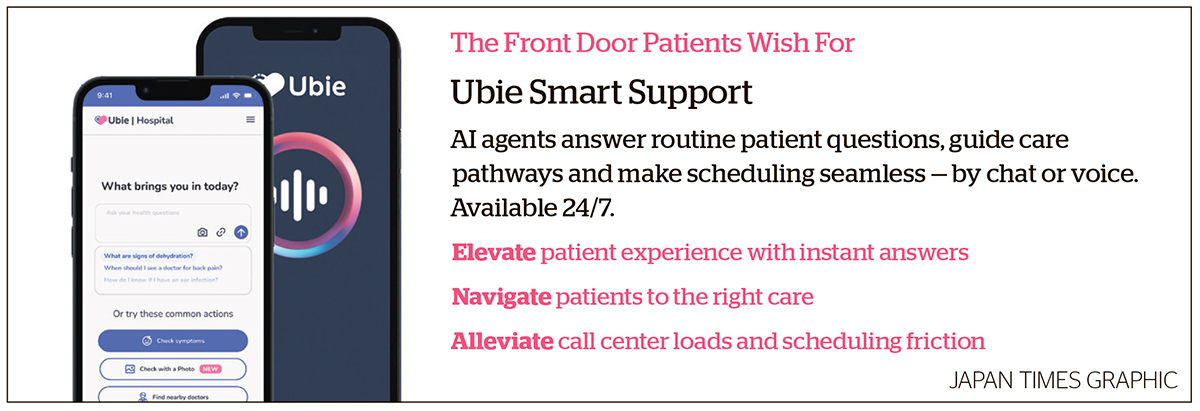
Complementing this is Ubie Smart Support, which replaces traditional call centers with automated AI-based intake agents that draw on patient data provided by the prestigious Mayo Clinic based in Rochester, Minnesota.
“We want to increase the efficiency of getting appointments,” Kubo explained, adding that Smart Support can even provide a form of triage. “If a patient has an emergency, we tell them, ‘This is an emergency, you should call 911.’”
Another key part of the startup is Ubie for Pharma, a partnership with pharmaceutical companies that aims to help “discover patients with rare diseases and navigate them to the right care.”
Through the Mayo Clinic Platform_Accelerate program, Ubie gained access to anonymized medical data from over 10 million patients. This dramatically increased the accuracy of the symptom checker, which does especially well in providing information about respiratory conditions and problems with the nervous system.
Today, Ubie’s services are used by over 1,800 medical institutions in Japan and roughly 90% of the top global pharmaceutical companies.
But for Kubo, technology alone isn’t enough. In his vision, AI shouldn’t replace doctors. Instead, it should empower them. “We don’t want AI to replace humans. Just some parts of their tasks,” he said.
Ubie believes the true power of AI in health care lies in balancing advanced language models with the indispensable human element. While some worry about the mechanical nature of such technologies, Ubie is constantly enhancing the tool’s warmth and empathy through user feedback. By keeping humans in the loop, the company ensures digital medical experiences have the potential to make health care equally accessible to people globally.
From Japan to the U.S., Ubie is proving that with the right balance of empathy and innovation, the dream of making good health care as “easily accessible as air” can become a reality.
This article is sponsored by the Japan External Trade Organization.

