


Nearly three years have passed since the government launched its Startup Development Five-year Plan in 2022. As a national strategy, the initiative is quietly reshaping the structure of Japanese society.
The number of startups has surged, university-driven technologies are finding their way into industry and overseas investment is flowing into Japan’s market. Global venture capital firms, meanwhile, are beginning to view Japan as their next growth hub.
The plan set ambitious goals: to grow the number of startups to 100,000, nurture 100 unicorns and attract ¥10 trillion in investment for fiscal year 2027, which begins in April 2027. The plan rests on three key pillars: building human resources and networks for startup creation, enhancing funding provision and diversifying exit strategies and promoting open innovation among large established companies. Each of these initiatives is designed to strengthen the foundations of Japan’s emerging startup ecosystem and encourage collaboration across industry, academia and government.
When the plan was launched, Japan had around 16,000 startups. Just a few years later, that number has climbed to 25,000 — a roughly 1.5-fold increase that underscores the rapid expansion of the country’s startup landscape.
Remarkable process so far
Hiroshi Ishikawa, director of Innovation and Startup Promotion at the Ministry of Economy, Trade and Industry, said that over the past three years, both domestic perceptions of startups and the way Japan’s startups are viewed abroad have changed dramatically.
Among the recent changes, Ishikawa highlighted the rapid rise of university-launched startups. Japan has long produced world-class research, yet much of it remained confined to academia without reaching broader society. That has begun to change, he said, as government policies have helped bring dormant intellectual property out of universities and into the market.
“Just in the past year, the number of university-based startups has increased by about 800, reaching a record 5,074 in 2024,” Ishikawa noted.
A symbolic example of this trend can be seen in startups born from Nobel Prize-winning research. RegCell Inc., founded by Shimon Sakaguchi, a specially appointed professor at Osaka University and Nobel Prize in physiology or medicine laureate, and Atomis Inc., a Kyoto University startup advised by Nobel Prize in chemistry laureate professor Susumu Kitagawa, are both companies that have received support from METI since their early stages.
RegCell is a biotech venture based on the research of Sakaguchi and his team, world leaders in immunology, who discovered regulatory T cells that suppress excessive immune responses.
Atomis, on the other hand, applies Kitagawa’s groundbreaking research on porous coordination polymers and metal-organic frameworks to develop new materials that enable safer and more efficient gas storage and separation.
Ishikawa also observed that international perceptions of Japan have shifted markedly since the government began implementing its startup policies. “Geopolitical tensions — particularly the rivalry between the United States and China — have created an increasingly uncertain environment for innovation,” he explained.
“Even within the U.S., universities and research institutions are facing structural challenges that have cast doubts on the future of scientific progress. Against this backdrop, Japan has demonstrated a clear, long-term national commitment to fostering startups and innovation as a core growth strategy. That stance, I believe, has led to a growing sense of expectation and confidence in Japan from the international community.”
Global Startup Expo 2025
Among startups, so-called deep-tech ventures — those built on breakthrough scientific and engineering innovations — are drawing growing attention as potential drivers of solutions to today’s complex global challenges, particularly from overseas investors.
Backed by cutting-edge research and advanced technologies, these startups hold the potential to create entirely new industries and fuel sustainable economic growth.
“Many global investors are especially interested in the seeds of innovation hidden within Japan’s universities,” Ishikawa said. “The country’s long-cultivated foundation of science and technology is once again coming into the global spotlight.”
The depth of Japan’s basic research is increasingly seen as an attractive source of investment opportunities.
In addition, the government’s clear commitment to bringing technology into society has led investors to view Japan as a market where they can take risks with greater confidence.
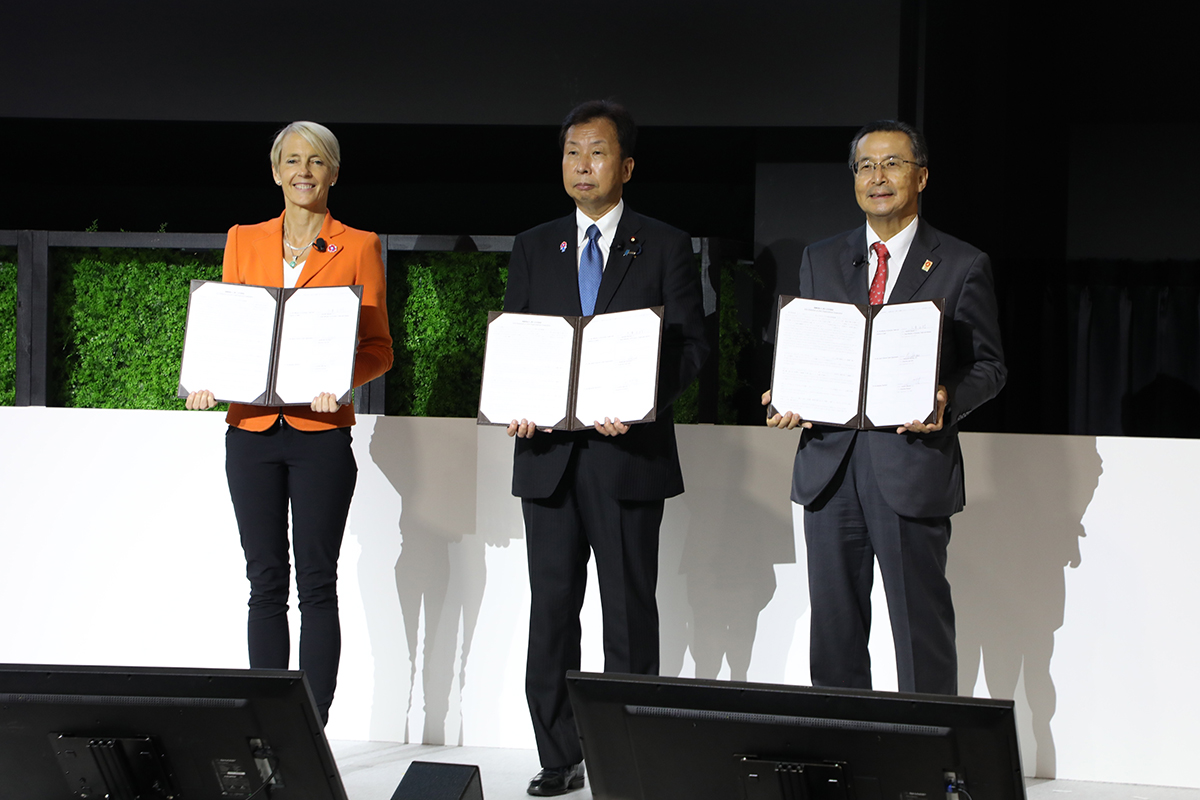
To further support this momentum, the ministry; the Kansai Bureau of Economy, Trade and Industry; the Japan External Trade Organization and the New Energy and Industrial Technology Development Organization hosted the Global Startup Expo 2025 in September at the Osaka Expo venue. The event aimed to support deep-tech startups and strengthen the inflow of global talent and investment into Japan.
The startup expo attracted many of the world’s leading venture capital firms. Among them, Alumni Ventures and New Enterprise Associates from the United States, Jolt Capital from France, SVG Ventures and Berkeley SkyDeck announced plans to expand into Japan, unveiling partnerships with Japanese companies and university-launched startups, coinvestment projects and the establishment of local offices. “Overseas investors are beginning to turn their interest in Japan into concrete action,” Ishikawa said.
According to Ishikawa, while the public announcements of investments by overseas venture capital firms were significant, what happened behind the scenes was even more meaningful.
“More than 1,000 business meetings took place over just two days,” he said. “Several of those have already moved into discussions on investment contracts or joint research.”
One of the event’s greatest strengths, he added, was that it enabled Japanese startups to meet and speak directly with senior executives from leading global VC firms — encounters that would normally be difficult to arrange.
“It was significant that we were able to design a policy framework that allows startups to connect directly with the world,” Ishikawa said, adding that the event will continue in the coming years with a focus on deep tech.

Inflow of global expertise
The growing presence of overseas VC firms in Japan represents more than just an influx of funding. “It will have a profound impact on Japan’s startup ecosystem,” Ishikawa said. “By bringing in investors with global networks, Japanese startups can gain direct access to international markets. At the same time, Japan is beginning to absorb the accumulated expertise and mentoring culture of investors who have helped grow companies such as Google and Meta.” Their experience in organizational development, fundraising and global expansion offers valuable lessons for Japanese founders seeking to grow beyond the domestic market.
To facilitate this process, the government is aligning business practices and governance standards with global norms, creating an environment where overseas investors and Japanese companies can collaborate more easily. “Investment is not the end goal, but the beginning,” Ishikawa said. “By incorporating international knowledge, we aim to help Japanese startups build the competitiveness they need to succeed on the global stage.”
Competing in global markets
The next challenge for the government is to help Japan’s technologies grow into globally competitive ventures. “It’s essential that the seeds of deep tech blossom in the global market,” Ishikawa said. To that end, the ministry is strengthening networks that connect Japanese startups with overseas investors and accelerators.
Key initiatives include the Japan Innovation Campus in Silicon Valley, JETRO’s Global Acceleration Hub and J-StarX, a program that sends young entrepreneurs abroad to gain hands-on experience in international ecosystems.
These platforms serve as bridges connecting Japanese startups with overseas VC firms, universities and research institutions.
Looking ahead, Ishikawa said the goal is to encourage global investors and accelerators to engage with the Japanese market, share international insights and help bring Japan’s technologies to the world.
By linking global perspectives with national policy, Japan aims to create a new cycle in which innovation born in Japan contributes to solving global challenges.
Bringing innovation to Japan
As Japan’s global networks continue to expand, Ishikawa is now turning his attention to how startup technologies can be implemented within Japanese society. “International expansion is important,” he said, “but we also want to accelerate the process of applying startup technologies and products here in Japan.”
The government and regional authorities have begun introducing startup technologies into public services, while major corporations are incorporating new ideas and technologies into product development. “We want to build a culture where established companies actively adopt startup innovations and become the first to use them here at home,” he explained.
By promoting both global outreach and domestic implementation, the government aims to enhance the long-term sustainability of Japan’s startup ecosystem.
In closing, Ishikawa highlighted what he sees as Japan’s core strengths. “The technological foundation built by Japan’s universities and major corporations over decades is our greatest asset,” he said.
“Another is the diversity of industries — particularly in manufacturing — where outstanding companies have long thrived.” Japan is home to world-class enterprises across a wide range of fields, from chemicals, materials and energy to mobility, health care and food. This depth and diversity form the fertile ground on which new startup challenges can take root and grow.
The future of Japan’s startup ecosystem lies at the intersection of academic knowledge, corporate experience and global capital. Having positioned startups as a national strategy, Japan is now nurturing its technological strengths and advancing toward a new phase of growth through co-creation.

