


Tokyo University of Science was founded as Tokyo Butsurigaku Koshujo (Tokyo Academy of Physics) in 1881. Under the founding spirit of “Building a better future with science,” TUS contributes to society by leading the advance of science, technology and the social adoption of research findings.
According to a 2024 survey by the Ministry of Economy, Trade and Industry on university-developed business ventures, TUS ranks sixth nationwide and second among private universities with 226, underlining its potential to promote the global adoption of new technologies.
The Japan Times recently interviewed Makoto Yamamoto, a professor of engineering and director of the Organization for Innovation and Social Collaboration at TUS. Yamamoto said that, as Japan’s social structure matures and its growth under conventional large-scale corporate models slows, university-developed startups will be the key to creating new industries and markets that can drive the nation’s economy.
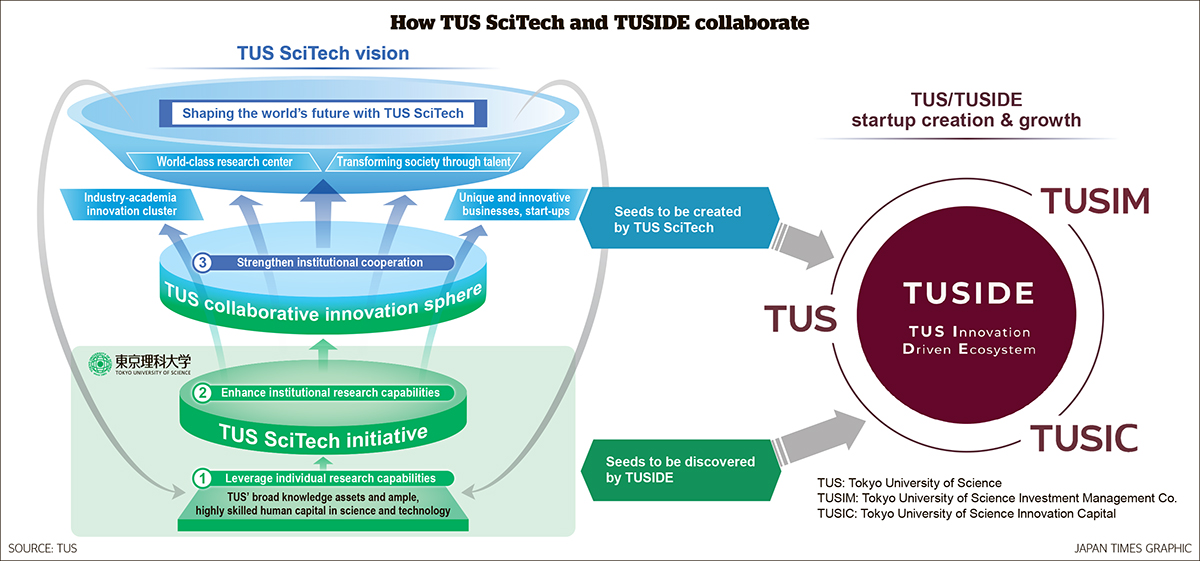
One of the goals of TUS is to discover the seeds of new business ideas and to encourage entrepreneurship while promoting industry-academia collaboration. To this end, the university formed a startup support system to maximize the application of its academic expertise and human resources: the Tokyo University of Science Innovation Driven Ecosystem.
TUSIDE comprises TUS and two “group companies” — the Tokyo University of Science Investment Management Co. and Tokyo University of Science Innovation Capital.
TUSIM organizes events and runs business-growth facilities, while TUSIC invests in startups and helps launch businesses. Altogether, TUSIDE acts as a seamless, one-stop shop for all phases of launching a business, from conceptualization and strategy to fundraising, scaling and the exit strategy.
So far, TUSIDE has invested ¥8 billion across 51 companies. This makes TUSIDE a vital part of TUS’ innovative approach, which introduces a top-down method to supplement traditional bottom-up support for entrepreneurs. The university calls this new approach “TUS SciTech.”
“The university thoroughly grasps all the research being conducted on campus and identifies the seeds of businesses within it. We also make suggestions about potential collaboration between specific researchers that could lead to interesting discoveries. If there are cases that could lead to forming startups, TUSIDE then takes over and offers support,” Yamamoto explained.
Of the more than 200 startups TUS has fostered, 39 have been officially certified by the university, including 12 established by current faculty members or students. Those certified receive benefits such as office space and guidance from the university’s startup support division.
Yamamoto said that TUS certification is a significant advantage when seeking collaboration. According to the University Fact Book 2025 compiled by Keidanren, METI and the education ministry, TUS ranks third among private domestic universities for joint research projects established with private domestic companies.
Many TUS-developed startups come up with innovative technologies that draw high international interest. For example, the robotics firm Innophys develops wearable exoskeletons to augment human mobility, while MediEng, which Yamamoto helped found, specializes in making 3D-printed models of organs. Meanwhile, materials firm XMat researches and develops ceramic matrix composites, which are capable of withstanding temperatures as high as 2,000 degrees Celsius.
Another company, Tsukarimakuri, uses highly concentrated minerals extracted from hot springs across Japan to develop various innovations, which they plan to expand to global markets soon. Then there is Blue Dia, which has developed a water treatment that uses underwater plasma to counter algae formation, a technology that can be applied to agriculture and other fields.
Yamamoto also highlighted startups in the fields of genetics, such as MycoGenome and Genomyl, and artificial intelligence — noting that .
TUSIDE also strives to be inclusive and accessible. “Technology has no borders,” Yamamoto said, affirming that the university will continue to support talented individuals of any nationality to spread innovative technologies globally.
The TUSIDE website, which provides information and consultations for starting businesses, is also available in English, making it invaluable to students and researchers of different backgrounds.
Other resources affiliated with TUSIDE, such as quantum cross point, a startup incubator that provides facilities to help businesses grow, are available to general companies and entrepreneurs unaffiliated with TUS. QCP has five locations in the Tokyo metropolitan area, with over 1,000 people using its office space and more than 490 companies and business owners registered as part of its network.
Yamamoto noted that, for TUS students, “Entrepreneurship education is incorporated at both the undergraduate and graduate levels, and we are seeing an increase in startups founded by students.”
He also explained that the university is receiving more and more questions and consultation requests from Japanese and foreign students aspiring to start businesses.
Going forward, Yamamoto hopes to draw more attention to all the ideas and technologies emerging from Japan. “We want to collaborate with people from various countries to expand and grow startups in Japan that will benefit the world,” he said.
This article is sponsored by Tokyo University of Science.


