


Techstars Tokyo is an equity-based accelerator that is reshaping Japan’s startup ecosystem by helping local founders think and act more globally while helping foreign founders connect with domestic enterprises, investors and talent.
The three-month-long program aims to change the business landscape of Japan’s capital at a transformative, crucial juncture. “Tokyo is very active and is being paid attention to by global players as an upcoming global startup hub,” said Yuki Shirato, managing director of Techstars Tokyo.
Japan’s startup environment, long considered insular and perhaps risk-averse, has evolved dramatically in the past decade due to a generational shift in mindset, government support and investment. “Venture capital has been flowing into the startups, not only from Japan, but also from abroad,” Shirato said, noting that startup funding grew tenfold between 2013 and 2023.
Those factors are key to unlocking Japan’s full startup potential. Powered by the Japan External Trade Organization and real estate giant Mitsui Fudosan (in cooperation with the government), Techstars Tokyo links early-stage founders with over 80 mentors, hundreds of investors and up to $120,000 (roughly ¥18.4 million) in funding, blending theory with real-world implementation.
JETRO brings its extensive network and support infrastructure while Mitsui Fudosan provides capital and a home base at Tokyo Midtown Yaesu across from Tokyo Station.
“It’s a magnificent space with an amazing view. The founders are very happy working there for three months,” Shirato explained. The available collective expertise and vast corporate network give startups unfettered access to Japan’s established business ecosystem, paving the way for their future innovations.
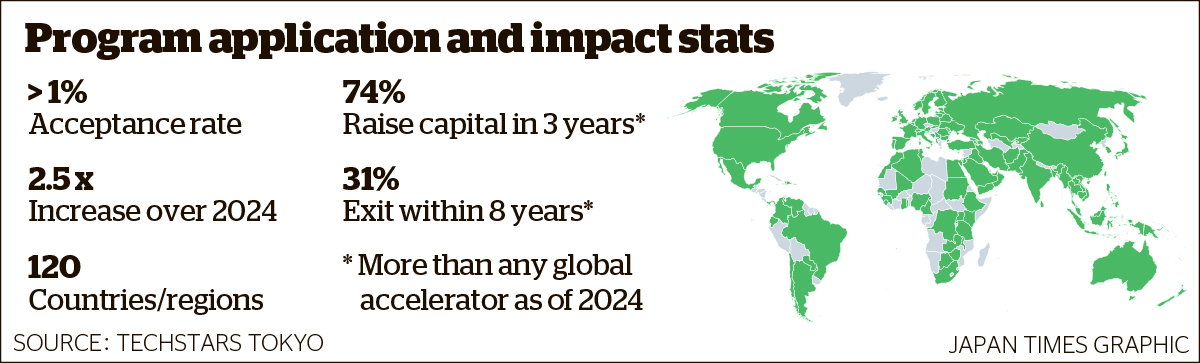
However, Techstars Tokyo’s mission extends beyond providing funding and office space. Its ultimate goal is to build a community in Japan with broad stakeholder support, and to nurture a global mindset among founders. The accelerator isn’t looking for people who only want to reach a Japanese audience and don’t feel the need for English language support or a global presence.
“If you want to build a product that can reach billions,” Shirato explained, that is the kind of idea Techstars Tokyo wants to see. Shirato admits, though, that this mentality cannot be taught, only brought out: “I can ignite their inner spirit, and I can encourage them, but it has to come from within.”
Japan still faces many challenges, like a hesitancy toward self-promotion. And many talents don’t use platforms like LinkedIn, hampering recruitment. Still, there is room for optimism.
“The younger generation doesn’t see a promising future by working at large corporations,” the director concludes, “so they do something completely different,” helping make Japan a global startup hub, with Techstars aiding them along the way.
This article is sponsored by the Japan External Trade Organization.

