


When a group of Japanese high school students were asked why, despite understanding the consequences of global warming, people continue making choices that harm the planet and vulnerable people, they honestly replied that even if they know fast fashion relies on exploitative methods of production, they still choose cheaper clothes because “convenience wins.”
Others reflected that the problems are too vast, leading to a sense of helplessness: individual actions seem too small to matter. We can all relate to this very human dilemma — the gap between knowing and doing.
As environmental lawyer James Gustave Speth said, “I used to think that the top environmental problems were biodiversity loss, ecosystem collapse and climate change. I thought that 30 years of good science could address these problems. I was wrong. The top environmental problems are selfishness, greed and apathy.”
Knowledge alone is not enough. To feel genuine motivation, we need deeper understanding and genuine care that connects to the reality of our daily lives.
How to galvanize change
The same dilemma sat at the heart of the Global Ethical Stocktake, a new process of dialogue created as part of preparations for the U.N. climate change conference, known as COP30, that was held in Belem, Brazil, in November. The GES invited people to reflect on the values, behaviors and responsibilities needed to fulfill commitments made at U.N. climate conferences. As the president of COP30 shared, “This requires more than data or technical knowledge — it requires courage, active listening, socio-environmental commitment and collaboration.”
The GES dialogues posed five questions: 1) Why we ignore scientific and traditional ecological knowledge, 2) Why we persist in harmful production and consumption models, 3) How wealthy countries and major emitters can do more, 4) What cultural or spiritual practices teach us to live in harmony with nature and 5) How we can mobilize more individuals, leaders, companies and nations toward just and ethical climate action.
Following a GES dialogue held in Addis Ababa in September, Kenyan activist Wanjira Mathai commented: “Today we heard a lot about trust; we heard a lot about inequity and inequality; we heard a lot about ethics. These are the issues that we believe will catalyze the transformation we need to see, so we can cushion ourselves against the worst impacts of climate change.”
Many faith groups held GES dialogues to reflect on how they could act to bring their values to life. The first Self-Organized GES Dialogue was cohosted on June 27 by the , of which Soka Gakkai International is a member. Local groups hosted GES dialogues in Brazil, India, Italy, Japan, Malaysia and the U.K., submitting their reflections both to the COP30 organizers and Earth Charter International, which promotes the values needed to build a sustainable world.
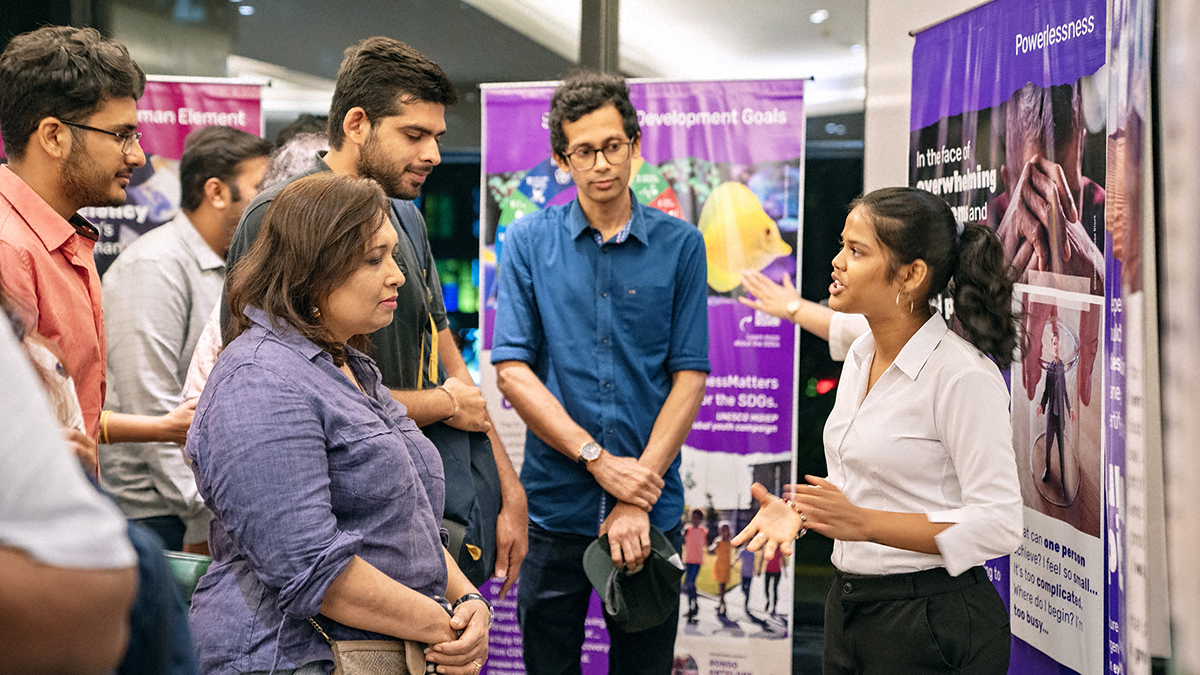
In India, 100 students from 22 schools and colleges gathered online for a Global Ethical Stocktake dialogue hosted by Bharat Soka Gakkai. They agreed that local choices — such as reducing single-use plastics or caring for neighborhood green spaces — can shape culture from the ground up. They described art, poetry and storytelling as powerful tools for shifting public consciousness and urged companies to collaborate with youth by offering sustainability internships. Their conclusion: ethical climate action begins when people feel these issues are their own, close-up and personal, rather than abstract.
A similar spirit emerged when the Soka Amazon Institute held a GES dialogue at a school on the banks of the Amazon River near Manaus in Brazil. Around 60 participants — including representatives from businesses, students, nongovernment organizations and the local secretary of the environment — discussed the real issues they face, from the changing rhythms of the river, to challenges faced by fishermen and riverside communities.
Faith in our shared future
Faith communities can play an important role in supporting a positive ethical shift — not by imposing moral authority, but by providing spaces where people can reflect, listen and find the courage and hope needed to act.
A in advance of COP30 called for civil society to work together and highlighted the role of faith groups: “Now more than ever, all religious traditions must serve as wellsprings of human conscience, guiding individuals to take action in response to the global challenges we face. Moreover, they are called on to play a more active role in inspiring the resilience of the human spirit — a spirit that refuses to give in, no matter how great the adversity, and rises to confront even the most daunting trials.”
Buddhism teaches that when we light the way for others, we also illuminate our own path. Caring for the environment is not separate from caring for one’s own dignity and well-being; it is an expression of our interdependence. A quote from the late Soka Gakkai leader Daisaku Ikeda reads: “Nature and humanity are one. … To destroy the natural world is to destroy the very foundation of human existence.”
Across the world, participants in the GES dialogues agreed that people are not lacking information — they need hope and belief. Belief that their actions matter, that change is possible even when the problem feels immense, that climate action begins not with distant actors but through the awareness that they, themselves, can come together in solidarity exactly where they are.
This article is sponsored by Soka Gakkai.

