


In the 58 years since its founding in 1967, the Association of Southeast Nations has grown from a five-member bloc comprising Indonesia, Malaysia, the Philippines, Singapore and Thailand into a 10-member one that brings together many of the nations in the region.
As was written at the time of ASEAN’s 30th anniversary, the organization’s foundational aims and purposes were about “cooperation in the economic, social, cultural, technical, educational and other fields, and in the promotion of regional peace and stability through abiding respect for justice and the rule of law and adherence to the principles of the United Nations Charter.”
This all took place against the backdrop of the conflict in what was then referred to as Indochina. There were also other intraregional conflicts, and the founding members came to share an awareness that developing a regional organization would be to everyone’s benefit. ASEAN was born as a result of the shared goal of “building a community of and for all Southeast Asian nations.”
Five more members have been added to ASEAN over the decades since. In the process, the organization has evolved into a dynamic regional bloc promoting peace, economic integration and cooperation.
This year, Malaysia assumed the rotating chairmanship under the theme of “Inclusivity and Sustainability.” Under its leadership, ASEAN is working to address a range of issues that come under each category.
In regard to the former, key issues that the organization will focus on include such matters as creating more equitable opportunities for growth by striving to integrate smaller economies — such as the soon-to-be 11th member East Timor — into the regional framework. Responding as a bloc to geopolitical challenges is another aspect that calls for encouraging unity.
Likewise, there are global challenges. One of these, as the chosen theme suggests, is sustainability. While pursuing economic growth and integration, ASEAN seeks also to maintain awareness of member states’ environmental responsibilities. In 2020, the organization had already begun issuing a report on U.N. sustainable development goal indicators to track the progress of meeting those goals. It now is also guided by the ASEAN Community Vision 2025, which again underlines the need to achieve a sustainable community that encourages social development while also protecting the environment.
‘Building Bridges’ in Osaka
Perhaps these efforts can best be understood through the concept of “Building Bridges,” the theme for the ASEAN Pavilion at the Osaka Expo currently underway through October. At a news conference in April, Commissioner-General for the ASEAN Secretariat at the expo Nararya Soeprapto spoke of how the expo provides a platform for nations to collaborate on global challenges.
Through the pavilion, he said, the bloc is demonstrating its commitment to a more integrated region. Taking a story-based approach, the pavilion presents examples of ASEAN’s successes and moreover illustrates how its mechanisms for cooperation and the like benefit not only the citizens of member states, but of other nations as well, precisely because of the organization’s emphasis on creating connections.
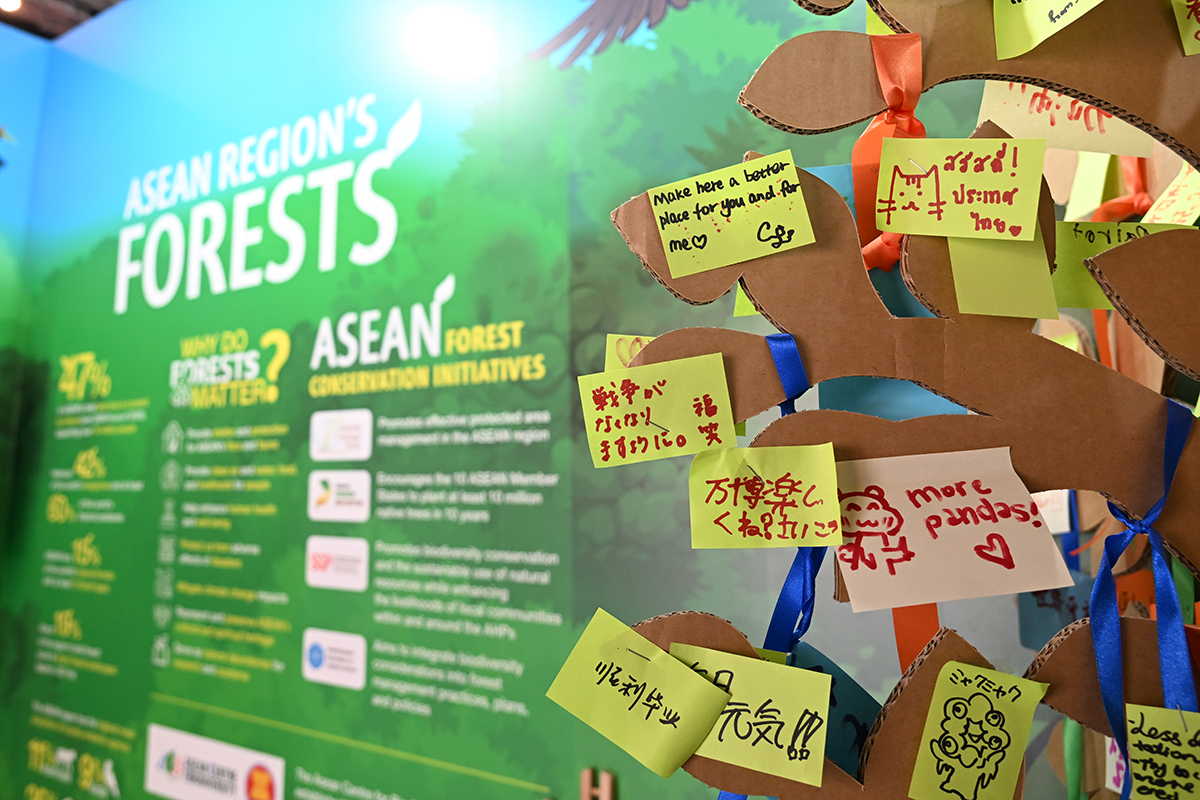
The stories and activities presented at the pavilion include a World Heritage Site and ASEAN Heritage Park virtual tour, an artificial intelligence station to immerse visitors in a virtual experience of the members’ culture and history, and presentations on such topics as building smart, sustainable and inclusive communities in ASEAN, Japan and elsewhere.

The timing of the expo also coincides with commemorations for the 58th ASEAN Day on Aug. 8. As Soeprapto pointed out, the organization plans to mark the occasion not only in Jakarta, but in Osaka as well. This is significant, he said, as it also provides the chance to celebrate the ASEAN-Japan relationship.
In remarks also delivered at the pavilion in April, ASEAN Secretary-General Kao Kim Hourn said that the group’s presence at the expo affirmed, in a sense, the bridges it has built with Japan. In particular, he highlighted how this aligned with ASEAN and Japan’s vision for friendship and cooperation at present and into the future. Underlying this, he said, was the desire to broaden and deepen their strategic partnership in several areas, including maritime cooperation, the pursuit of sustainability goals and economic affairs.
Kao also emphasized that because of its focus on dialogue and cooperation over division and competition, the expo provides a venue for nations to showcase the mutual benefits of economic integration. Sustainable global progress, he stressed, demands continued collaboration. Hence, he said, participation provides the opportunity to build bridges among nations — not only within ASEAN, but also with partner countries — at every level from the governmental to the individual, and to showcase for all the potential of the region.
Enduring relations
The shared vision between the group and Japan of which Kao spoke dates back to a joint vision statement and implementation plan that the two parties issued in December 2023 to mark the 50th anniversary of ASEAN-Japan Friendship and Cooperation.
The group’s participation in the expo builds on this, but the legacy of ASEAN-Japan ties dates back all the way to 1973 when the two parties established informal dialogue relations. These were formalized four years later with the establishment of the ASEAN-Japan Forum.
Political and security cooperation has been a core element of this partnership from the start, but the relationship extends far beyond that into other realms. The two parties see their comprehensive strategic partnership as also encompassing economic and sociocultural cooperation, as well as expanding connectivity and narrowing the development gap among the region’s nations.
ASEAN has seen Japan as a long-standing and trusted partner across a broad spectrum that ranges from trade and investment to education, disaster management and capacity-building. At a joint forum this March in Karuizawa, Nagano Prefecture, officials from the bloc and Japan emphasized that this partnership remains strong.
At that forum, representatives stressed the progress that has been made in realizing the statement and implementation plan. Japan also reiterated its support for the group’s efforts to both strengthen its core and to build communities. ASEAN welcomed Japan’s commitment to pursue various projects and activities in support of initiatives that would foster cooperation.
Beyond this, Japan and the member states continue to collaborate through a variety of other frameworks and initiatives.
One example of the former is the ASEAN-Japan Comprehensive Economic Partnership framework that reduces or eliminates border tariffs among the signatory parties on certain products and materials, including iron, ore, semiconductors and automotive parts.
As to the latter, both Japan and ASEAN have broadly agreed that it is necessary to preserve a free and open Indo-Pacific region with ASEAN at the center. ASEAN and Japan share the goal of dialogue and cooperation within the region, improving intraregional physical connectivity and ensuring development and prosperity for all.
Aside from geopolitical and economic matters, ASEAN and Japan have also seen exchanges at the more personal level. Needless to say, tourism is probably the most readily accessible avenue for people-to-people exchanges, and the sector appears to be thriving.
For example, the ASEAN-Japan Centre says that, as of 2022, around a quarter of the foreign visitors to Japan came from ASEAN countries. Meanwhile, Japan ranked 11th in 2023 as a source of foreign visitors to member states, placing behind only more populous countries such as China and India and intraregional states. Educational exchanges and cultural diplomacy are also thriving. For example, Japan has been inviting students from member states to study here through its Japan-East Asia Network of Exchanges for Students and Youths program since 2007.
Conversely, in recent years the ASEAN University Network in collaboration with the Japan Foundation and Kyoto University has been inviting Japanese students to come to group countries through the ASEAN-Japan Youth Forum. Furthermore, since 2023 the Japan Foundation has been pursuing ASEAN-focused people-to-people initiatives that include two-way intellectual and culture exchanges.
Shared priorities, outlook
Underscoring these varied initiatives on the parts of both ASEAN and Japan, as outlined in the ASEAN-Japan comprehensive strategic partnership, is a shared commitment to sustainable development and inclusive growth. That statement notes the interest of both in cooperating to address regional and global challenges ranging from climate change to public health and beyond.
One of the ultimate goals, as the joint vision statement stresses, is for ASEAN and Japan to be partners in the co-creation of a prosperous and sustainable economy and society that is diverse, inclusive and resilient — some of the very themes highlighted at the ASEAN Pavilion at the expo.

